
Inheritance
Earlier this month our mum, always “Maw” to her kids, died after six long years of vascular dementia. The finality of it, coupled with trying to excavate memories ahead of her funeral has sent me into a frantic tailspin since, wondering whether I could still remember who she’d been before the disease. Our Maw, our real Maw, was already much more deeply buried in my memory than I wanted to admit.
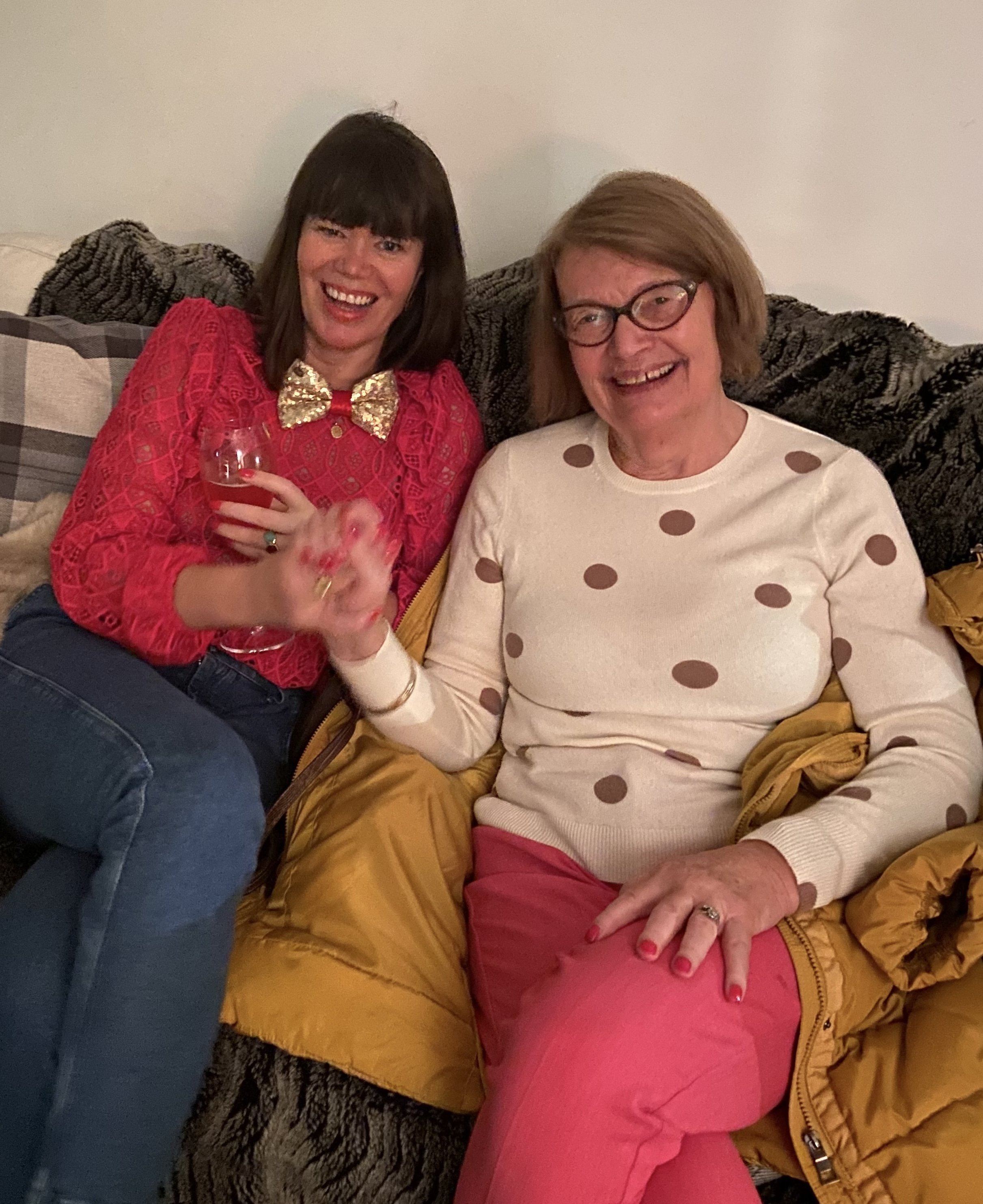
When Maw let me dress her up in my getup. She couldn’t believe she was wearing a pair of “pink troose”. Two experts in laughing off the hard stuff.
I’ve always been terrible at deleting emails so I knew I’d be able to find her in my hotmail archives. She was there often, consistently steadfast, fixing and helping and joking, lighthearted stuff about neighbours, dogs, siblings and wildlife. Very rarely any mention of what she was actually living through: One of the first emails I opened was from 2006. She had just left her marriage but was still having to effect the sale of the family home which my dad was refusing to leave. The practical realities of her life, the anxiety and feelings of entrapment that must have accompanied it, barely surfaced. The email was simply titled “Otters”.
So I found her there in the emails, reassuringly, but I also found someone I didn’t recognise: myself. This young woman who was bantering back and forth with her Maw was light-hearted, unburdened, full of nonsense; someone I couldn’t remember ever being. Much of my twenties and thirties, as I remember them, were wild as the hills but, as a self-employed artist always on the move, they also felt rudderless and utterly precarious.
Maw had had a full and highly respected career as a solicitor, but even though she was retired by then, I was horrified to see in our emails just how much I’d asked of her while I was living abroad in my thirties. She organised UK couriers, chased galleries for unpaid invoices, opened my post and seemed to spend an inordinate amount of time on the phone to my bank in the days before online banking.
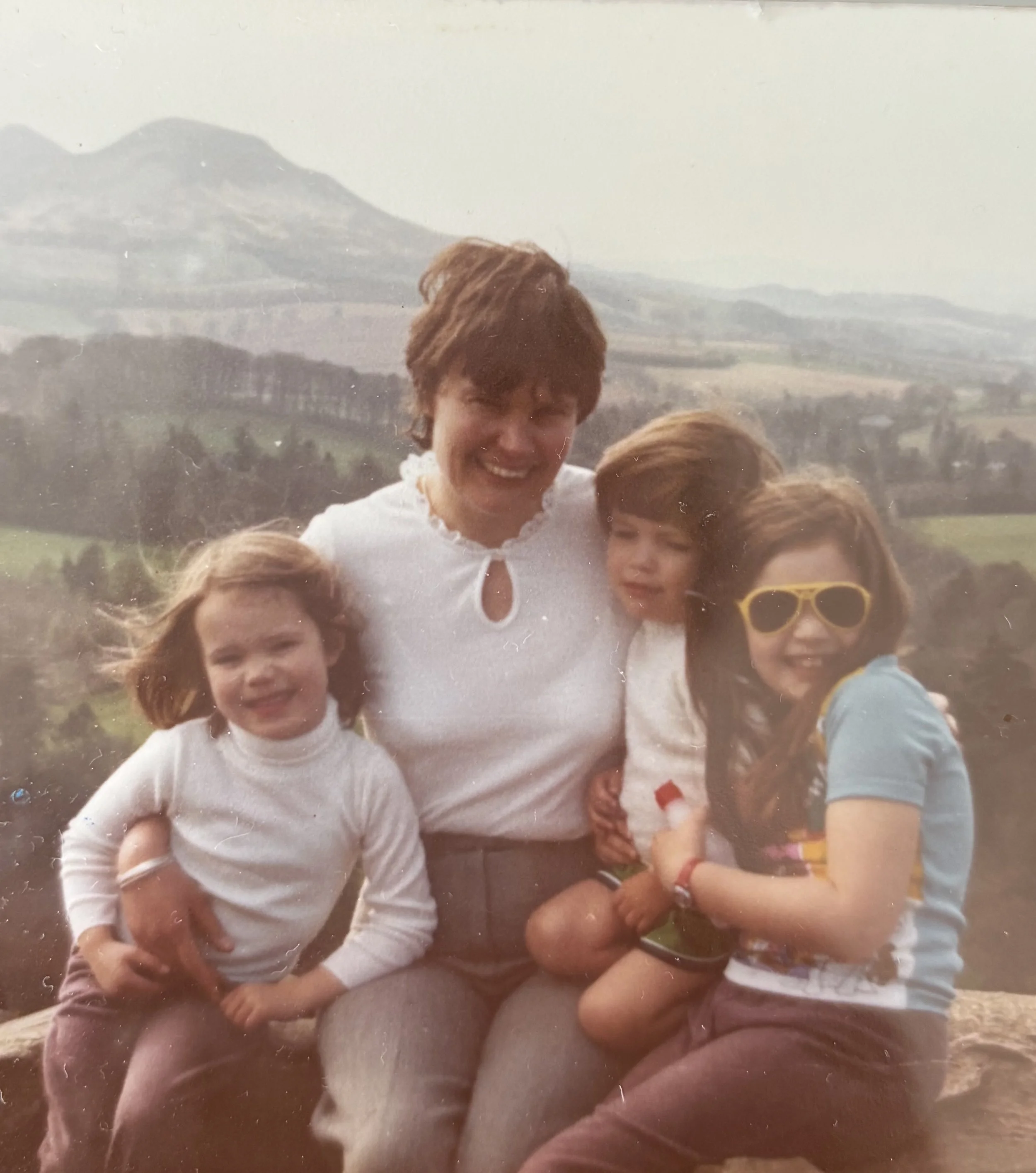
Maw with her brood, quietly holding it all together, near our home in rural West of Scotland, 1981 ish.
In one of her emails, incongruously titled ‘My favourite caterpillar from Crete!’, she sensed (correctly) that I was struggling financially. She told me she’d found an insurance policy she’d been paying into since I was born which was about to mature and wanted to give me several thousand pounds. I replied:
“...re. cash - a princely sum, many thanks mamma, you really are amazing - I doubt I would ever be shrewd or rich enough to pay into insurance policies for my hypothetical children when and if I ever settle down...”
Only now do I realise how fortunate I was to have a retired solicitor as a mum who was quietly invested in making sure I didn't crash and burn. I relied on her completely. Without her quiet strength in the background, I don’t think I would ever have had the confidence to risk financial disaster on the regular, move countries on a whim or become an artist at all.
I noticed that my emails often embellished the "opportunities" I was finding abroad, exaggerated the sales, over-egged the fun times, minimised the boyfriend issues and glossed over the anxiety. Perhaps, without realising it, I'd learned to speak Maw's language. Her otters and caterpillars sat alongside my exaggerated adventures and improbable successes. We talked around our inner lives rather than directly through them, offering each other partial, but nonetheless truthful versions of ourselves.
When I emailed to ask if she could meet me at Glasgow Airport with a wheelchair after I’d fallen out of a window and ended up in hospital in China, she didn’t ask what the hell her thirty-something daughter had been doing falling out of windows. Instead she replied:
“I was nearly in Casualty myself on Monday as I fell on slippy wet ground and twisted my foot... hopefully fine by next week otherwise we’ll be a bonny pair of crocks in the airport!”
The more emails I opened, the more I recognised that this was how Maw expressed love: through attention, action, humour and reliability.
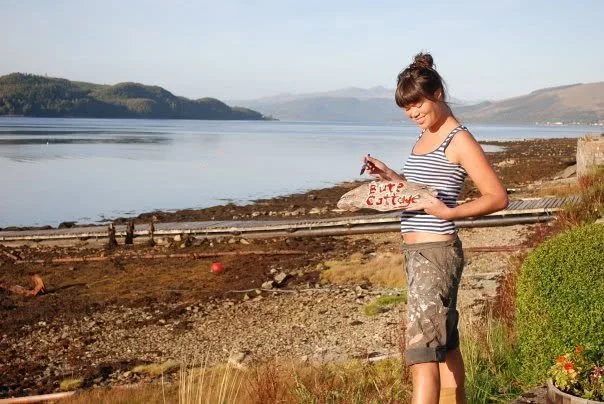
Happier times up, painting my Maw’s wee cottage sign outside her home on Loch Fyne, cerca. 2010
When we handed my Chinese X-rays to the doctor at the Southern General, we spent far more time laughing about the fact that the only English word on the envelope was “PASTY” (as in cheese and onion) than we did discussing how I’d ended up there. It seemed to be the only detail either of us was interested in.
Before emails, I remember during my art school days in the late 90s she had another way of saying things without saying them. Every so often an envelope would arrive to my student halls containing a newspaper cutting about another young person who’d died after taking ecstasy. There was never a note but the message was clear; “I see you, be careful.” My brother, living in America, got cuttings about Scottish football instead.
Arriving home for summer from my first year of art school, I decided it was time to get my new smoking habit out on the table - literally. As I smacked my pack of Malby Lights down in the kitchen with nervous bravado, I braced for some extreme reaction from Maw, but after an initial “You’re not a smoker now are you?” She produced a massive quartz ashtray previously owned by her own mum, and I proceeded to choff away to my heart’s delight in the kitchen. As the clean clothes on the pulley above got engulfed in a thick grey cloud, my siblings looked on incredulous.
During the last few years of her life I occasionally drew Maw in an attempt to understand what might be happening in her mind. I found the drawings almost impossible to look at afterwards and gradually abandoned observation in favour of introspective, expressive sketches that tried instead to understand what was happening in mine.
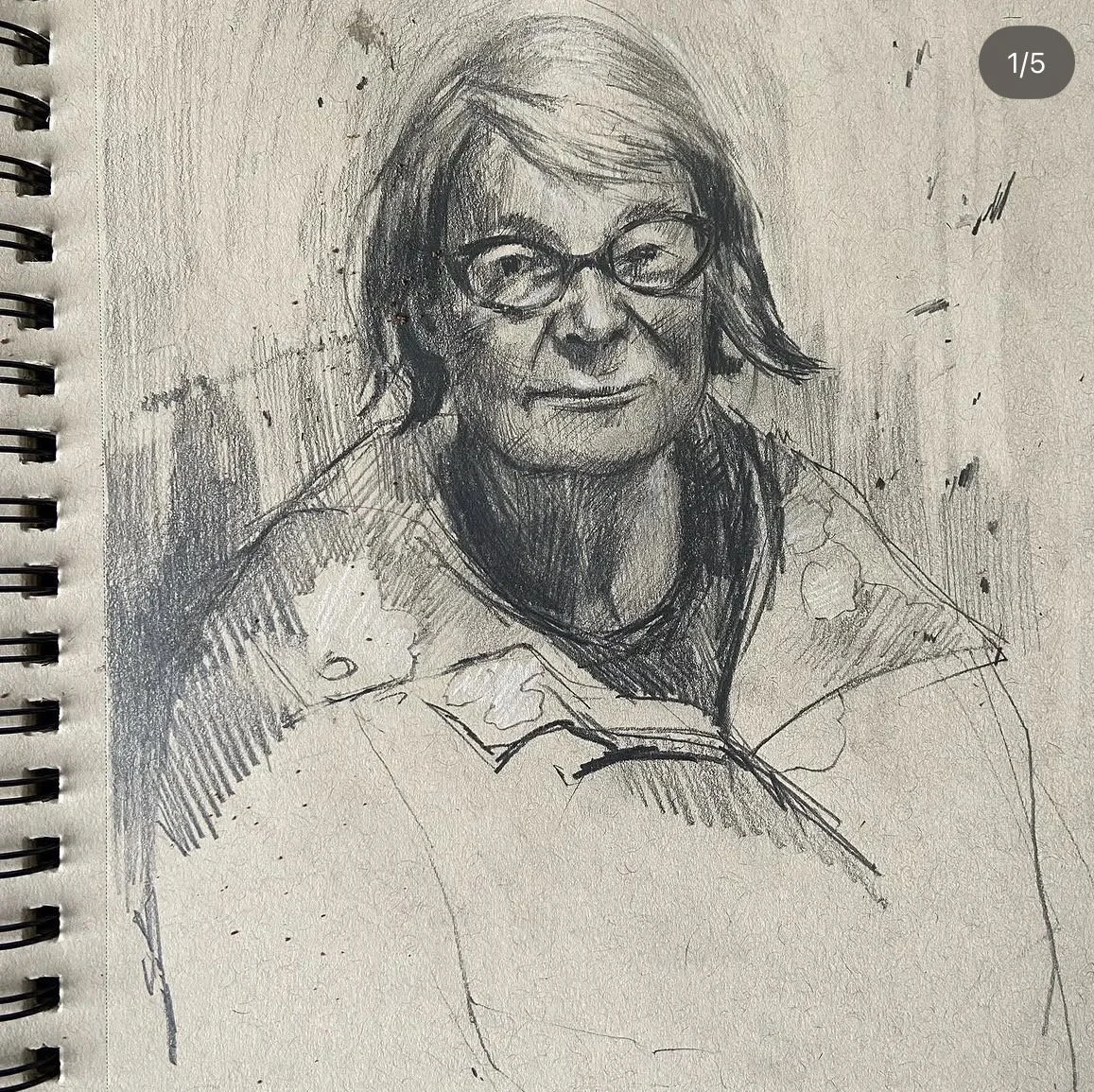
An observational sketch I made of Maw, 2022 once the dementia had really taken hold.
That was the real beginning. By last summer I’d committed to abandoning the realist work that had defined my career for two decades in favour of a much more instinctive way of making art. I had no idea where it would lead.. I’d also started writing for the first time and I could sense some fairly major shifts in me happening at a deep level. By this point our mum only spoke very occasional words if we were lucky, didn’t seem to recognise us and I found our monthly visits to see her in Scotland basically just harrowing. I thought about her a lot, tying myself in knots trying to make sense of her life and the heartbreaking way it was very slowly and painfully ending.
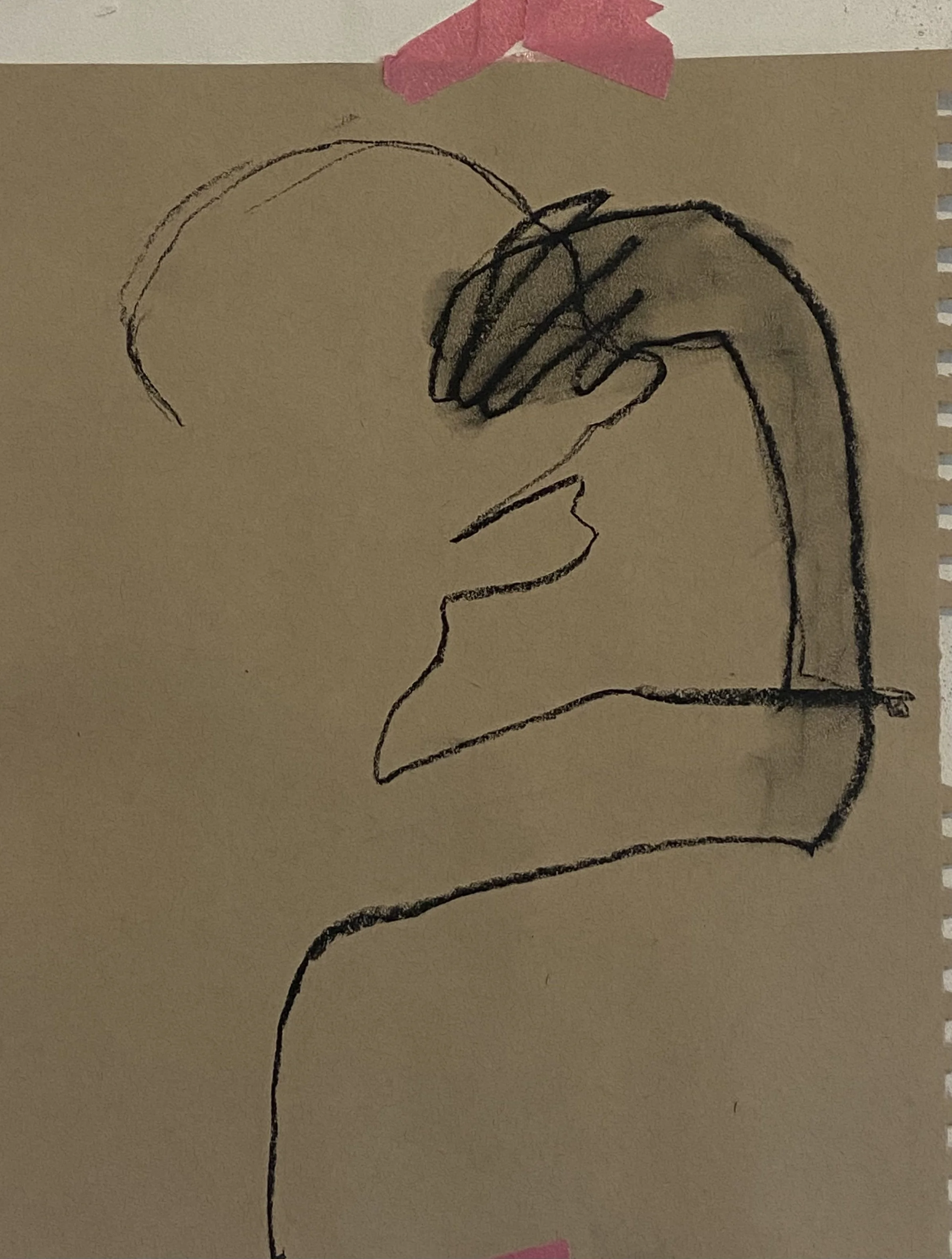
A sketch I made in 2024 following a visit, thinking about The Future…
Walking around Brighton, I found myself returning again and again to threshold moments in my mother’s life, slowly recognising their echoes in my own.. In her early 60s, after decades in a horribly difficult marriage, my mum finally found the strength to leave. We were right there, cheering her on but it was no mean feat as a woman of her generation to up and leave and to force the sale of the family home. Outside the household, our dad was widely respected. Inside it, our experience had been very different. It took a great deal of courage to get out.
Although she could never quite shake off the (misplaced) guilt she felt for leaving, she finally found her hard-earned freedom in a tiny cottage on the banks of Loch Fyne with her dogs, where she swore off men for life.
The comparison between my ending and my mum’s felt absurd. My mother had left a marriage that had defined decades of her life. I was changing the way I made my art. And yet, beneath the obvious differences, I couldn’t ignore what they seemed to have in common. Both required letting go of an identity that no longer fit. Around that time, a series of realisations began to gather. I started to understand how much of my life had been shaped by an inherited perfectionism, by the pressure to get things right, learned in a home dominated by my father’s need for control. As that understanding deepened, its hold over me began, slowly, to loosen.
Only then did I recognise what Maw had given me. Not simply the example of leaving, but the courage to do it. In changing my work last year, I wasn’t only leaving behind an artistic identity. I was, finally, leaving my father too.
Only afterwards did I begin to understand the scale of what she’d carried. One of very few women practising law in Scotland in the late 1960s and early 70s, she built a respected career while quietly holding together a family that often felt on the verge of splintering. “Cheer up, old fruit” was her mantra if any of her kids were struggling. She absorbed so much of a turbulent home life, shielding us from its full force and, somehow, still providing the conditions to become ourselves.
She allowed me to make a life on my own terms, to become an artist and, years later, to become a different kind of artist. She showed me how to leave and begin again; to smack my fags back down on the table at fifty, and trust that the work could carry more of me.
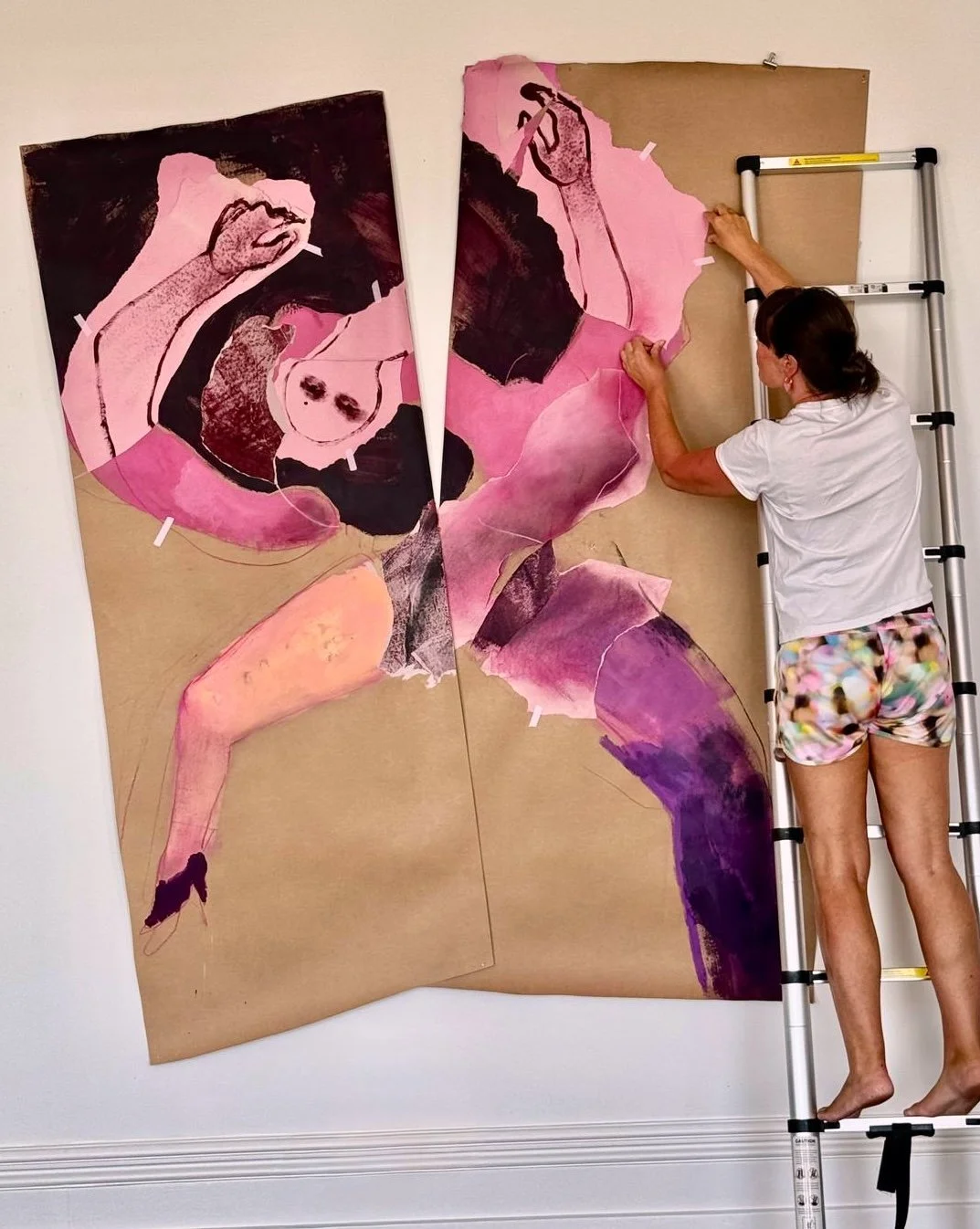
Rebuilding, 2026